Why Tracking Streaks Backfires - and the Three Numbers Worth Counting Instead

Quick Answer: A streak makes one missed day cost everything, which turns a minor lapse into a reason to quit. The all-or-nothing structure that makes streaks motivating early is exactly what makes them fragile later. Count these instead: sessions per week (target a range, not a number), sessions in the last 28 days, and the longest gap between sessions. All three tolerate a missed day. None of them can be destroyed by one.
The goal is a metric that says ‘you are doing fine’ on a bad week, because that is the week that decides whether you continue.
Streaks say the opposite, loudly, on exactly that week.

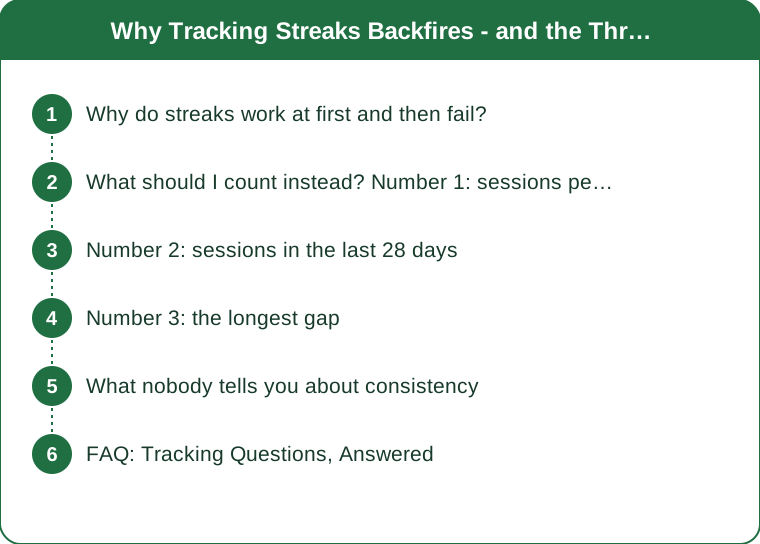
Why do streaks work at first and then fail?
Because they front-load motivation and back-load risk.
Early on, a streak is nearly free. Day 3 costs nothing to protect. The number grows, it feels good, and the reinforcement is genuine.
But the value of the streak keeps rising while the probability of an interruption stays constant. Life produces illness, travel, deadlines, and bad nights of sleep at a fairly steady rate. Given enough days, an interruption arrives - not because you failed, but because time passed.
And when it does, you lose everything you built at once. Psychologists describe versions of this as the what-the-hell effect: once a self-imposed rule is broken, adherence often collapses well below where it would have been with no rule at all.
Day 42 does more damage than never starting a streak would have, and that is a structural property, not a character judgment. The metric was designed to be all-or-nothing, and it delivered.
What should I count instead? Number 1: sessions per week, as a range
Set a range, not a target. For example: 3-5 sessions per week.
A range does two useful things. The bottom number is a floor you can hit on a bad week, and hitting it counts as success rather than as falling short. The top number stops the good weeks from setting an unsustainable expectation.
Why ranges beat targets: a single number is a pass/fail test that you fail roughly half the time by design. A range converts most weeks into wins, and the weeks you feel good about are the weeks you repeat.
Choose your floor honestly. It should be the number you could hit during a genuinely difficult week - not the number you hit when everything is going well. For most people that is two. A floor of two that you meet 50 weeks a year beats a target of five that you meet for six weeks.
The week resets on its own, which is the whole point. A missed Tuesday is recoverable by Saturday, and nothing is destroyed.
Number 2: sessions in the last 28 days
This is the metric that best reflects reality, and almost nobody uses it.
A rolling 28-day count smooths out the noise. A vacation week or a bout of flu barely moves it. A gradual slide downward shows up clearly, weeks before you would have noticed on your own.
How to read it:
- 12-20 sessions in 28 days: consistent training. This is the zone.
- 8-11: maintaining. Fine during a busy stretch.
- Under 8: the habit is fading. This is the number that tells you before you have already stopped.
Why rolling beats calendar months: a calendar month resets on an arbitrary date and lets a bad start feel like a write-off. Rolling windows have no reset, so there is never a moment where the month is ‘already ruined.’
Most tracking apps will show you this if you look, and a paper calendar with an X per session gives you the same thing by counting backwards for a minute.

Number 3: the longest gap
The single most predictive number, and the least tracked.
Total sessions tell you how much you did. The longest gap tells you how close you came to stopping. Twelve sessions in a month spread evenly is a habit. Twelve sessions crammed into ten days followed by eighteen days off is a habit that already broke and got restarted.
The threshold that matters is about 10-14 days. Beyond that, the routine loses its automaticity and coming back requires deliberate effort rather than just showing up. That is the gap that turns into a month.
How to use it: just note your longest gap each month. If it is creeping up - 4 days, then 7, then 11 - the habit is degrading even if your weekly average looks fine.
The action it prompts is small. When you notice a gap approaching a week, do a deliberately trivial session. Ten minutes. The point is not the training effect; it is resetting the clock on the gap.
This is where a defined minimum session earns its keep - write down an eight-minute version now, before you need it.
What nobody tells you about consistency
Four things that change how this feels.
Nobody is consistent in the way they imagine other people are. Long-term exercisers have gaps, bad months, and stretches of doing almost nothing. What distinguishes them is a short average gap, not the absence of gaps.
Restarting gets faster every time you do it. The first restart is hard. The tenth takes an afternoon. Practice at restarting is a genuine skill and streak-thinking prevents you from developing it.
Motivation is not the variable to optimize. It is famously unreliable and it drops sharply somewhere around the third week of anything. Systems that assume low motivation survive; systems that require high motivation do not.
Late summer is a better restart point than January. The weather is still cooperative, schedules are firming up as the school year starts, and you are not competing with a crowded gym or the weight of a New Year narrative. A September restart has better odds than a January one, and the reason is mostly structural - it arrives with a real schedule change rather than a symbolic date.
FAQ: Tracking Questions, Answered
Should I stop using my streak app entirely?
You can keep it and stop caring about the number. The problem is not the display, it is treating the streak as the goal. If breaking it would make you quit, it is doing harm.
What if streaks genuinely motivate me?
Use them with a built-in rule: one planned rest day per week does not break the streak. Adding legitimate off days makes it survivable. The all-or-nothing version is the one that fails.
How long before a habit feels automatic?
Research on habit formation puts it broadly in the range of a couple of months, with wide individual variation - the popular 21-day figure has no strong basis. Plan for months, not weeks, and track accordingly.
TL;DR:
- Streaks make one missed day cost everything - fragile by design, and the collapse is predictable.
- Count sessions per week as a range with a floor you could hit in a bad week (often two).
- Track a rolling 28-day session count - under 8 is your early warning.
- Watch your longest gap. Past 10-14 days the habit loses automaticity; a 10-minute session resets it.
- A September restart beats a January one because it comes with a real schedule change.
Write three numbers on a sticky note this week. They will still be telling you something useful on the week a streak would have been telling you to quit.
Keep Reading
This article is for general informational and styling purposes only. Fit, sizing, and product availability may vary.