Why a Fitness Goal That Depends on a Facility Breaks First

Quick Answer: Every additional condition a habit depends on multiplies the ways it can fail. A goal requiring a facility, a commute, an opening time, equipment availability and childcare has five failure points, and the probability they all hold on any given day is the product of five probabilities, not the average. Goals with fewer dependencies survive longer, not because they are easier, but because there are fewer days on which they are impossible. The strongest structure is a facility-based primary plan plus a zero-dependency fallback.
The gym plan is better training. Nobody disputes that.
It is also a plan that requires roughly five things to be true simultaneously, several times a week, for months, and that is where the goal actually gets decided.

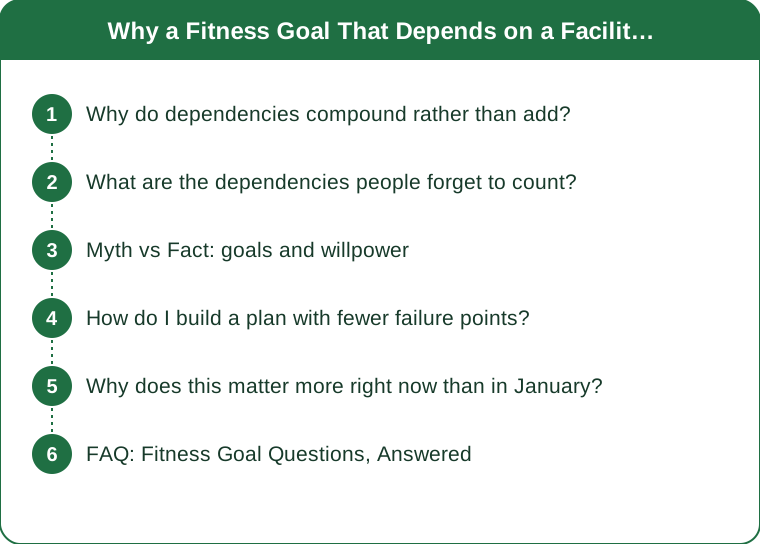
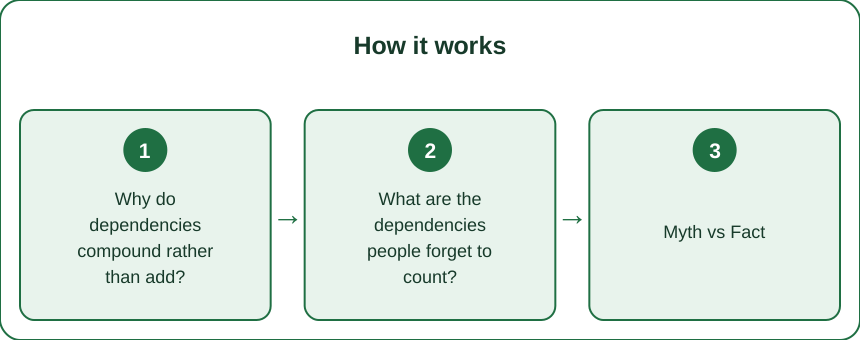
Why do dependencies compound rather than add?
Because they have to hold at the same time.
Say each condition holds 90 percent of the time: the gym is open, you have time for the commute, the equipment you need is free, childcare works, and you are not too tired after the travel.
Each one individually sounds reliable. Together, 0.9 to the power of five is about 59 percent. Four in ten planned sessions fail for reasons that have nothing to do with motivation.
A home session with one dependency, twenty minutes of time, holds at something much closer to 90 percent.
This is not an argument that home training is better training. It is an observation about how often the plan is executable at all, and adherence is the variable with the largest effect on long-term outcomes in almost every training study.
Does this mean gyms are a bad idea?
No. It means a gym-only plan is fragile, and the fix is a fallback rather than abandoning the gym.
What are the dependencies people forget to count?
The obvious ones get counted. These are the ones that quietly break plans.
Daylight. Any goal involving outdoor exercise after work has a hard expiry date in autumn. A plan that works beautifully in August stops working in late October because the light disappears, and people experience this as losing motivation rather than as losing a dependency.
Weather. Related but separate. Outdoor plans with no indoor equivalent lose days across the whole winter.
A specific class time. A class at 6:30pm depends on leaving work at a specific hour every week. One recurring meeting kills it.
Specific equipment. A programme built around a machine that one person uses for forty minutes at peak time has a dependency you did not choose.
Another person. A training partner doubles the number of schedules that have to align. Genuinely valuable for accountability, and a real fragility cost.
Your own energy at a specific time of day. A 6am plan depends on sleep the night before, which depends on the previous day.
Clean laundry. Trivial, and it ends more individual sessions than people admit.
Myth vs Fact: goals and willpower
Myth: Missed sessions are a motivation problem. Fact: Most are logistics. The distinction matters because motivation interventions do not fix logistics problems, which is why trying harder rarely works on a fragile plan.
Myth: A harder goal produces more commitment. Fact: Goal difficulty improves performance up to a point and then reduces it, particularly when the goal requires conditions outside your control. A goal you can execute on a bad day beats an ambitious one you can only execute on a good day.
Myth: If you really want it, you will find a way. Fact: Habit research consistently finds that context stability and reduced friction predict habit formation better than stated commitment does. This is one of the more robust findings in the area.
Myth: Home workouts do not work. Fact: For general fitness, strength and health outcomes, home training with minimal equipment produces excellent results when done consistently. The gap between home and gym is much smaller than the gap between training and not training.
Myth: Once the habit forms, the dependencies stop mattering. Fact: Established habits are more robust but they are still context-dependent. This is why habits collapse after a move, a job change, or a schedule shift, and why autumn breaks so many summer routines.

How do I build a plan with fewer failure points?
The structure that works is two-tier, and the second tier is the part most people skip.
- Tier one: your actual plan. The gym sessions, the class, the run route. Keep it, because it is better training and you will do it most weeks.
- Tier two: a zero-dependency fallback. Twenty minutes, at home, no equipment or one item, that you can do at any hour. This is not a compromise version of tier one. It is a separate, permanently available option.
- Define the fallback before you need it. Write down the exact exercises. A fallback you have to design at 9pm on a bad Tuesday will not happen.
- Set the standard as never two in a row missed, rather than as a weekly session count. This makes the fallback’s job clear: it exists to prevent the second miss, which is where routines actually die.
- Audit the dependencies once at the start. List everything that has to be true. Anything you can remove, remove.
What should the fallback actually be?
Something like: 3 rounds of 10 squats, 8 push-ups on any elevation, 12 hip hinges, 30 seconds of a plank, 20 reverse lunges. Fifteen minutes, no equipment, no travel. It does not have to be optimal. It has to be always available.
Why does this matter more right now than in January?
Because the dependency landscape is changing under everyone’s feet over the next eight weeks.
Daylight is contracting fastest around the equinox. Through September and October, evening light disappears at close to its maximum rate. Any routine anchored to after-work daylight is on a countdown right now, whether or not it feels like it.
Schedules reset. School terms, work cycles and social calendars all shift, which breaks the context stability that habits depend on. A routine formed in July is being run in a different environment by October.
And this is exactly why September restarts are common and also why they fade in November. People restart on the enthusiasm, build a plan around the conditions that exist in early September, and hit a wall when those conditions change.
The practical move is to build the winter version of the plan now, while motivation is available, rather than in November when you are already missing sessions.
- Move outdoor sessions to weekends or mornings before the light goes.
- Identify the indoor equivalent for every outdoor session, in advance.
- Assume the 6:30pm class will get harder to reach once it is dark and cold, and decide now whether it stays.
A plan built for the conditions eight weeks out survives the transition. A plan built for today’s conditions gets rebuilt from scratch in November, and rebuilding is where most goals are abandoned.
This is general information, not medical advice.
FAQ: Fitness Goal Questions, Answered
Is it worth paying for a gym I only use twice a week?
Often yes, if those two sessions are things you genuinely cannot do at home. The mistake is expecting the membership itself to solve the adherence problem.
How long does a habit take to form?
The popular 21-day figure has no good evidence behind it. Research on automaticity finds a wide range, commonly cited around 66 days on average with enormous individual variation.
Does tracking help?
Moderately, and mainly for recording rather than for streaks. Streak-based tracking creates a penalty for a single miss, which is precisely the moment you most need the routine to be forgiving.
What if the fallback becomes the whole plan?
That is a completely acceptable outcome. Fifteen consistent minutes beats an unused membership by a wide margin.
TL;DR:
- Dependencies multiply. Five conditions at 90 percent reliability each leave you executable only about 59 percent of the time.
- The forgotten dependencies are daylight, weather, class times, shared equipment, other people and your own sleep.
- Missed sessions are usually logistics, not motivation, and motivation fixes do not solve logistics.
- Build two tiers: the real plan, plus a defined zero-dependency fallback whose only job is preventing a second consecutive miss.
- Build the winter version now, because evening daylight is contracting fastest over the next eight weeks.
The goal that survives is not the ambitious one or the easy one. It is the one that is still possible on the worst available day, and that is a design decision you make before you need it.
Keep Reading
This article is for general informational and styling purposes only. Fit, sizing, and product availability may vary.