Why Motivation for a New Fitness Goal Consistently Drops Around Day Seventeen

Quick Answer: Motivation for a new fitness goal tends to dip around the two-to-three week mark because the initial novelty and dopamine boost of starting something new fades on a fairly predictable timeline, while the habit hasn’t yet become automatic enough to run on its own — this gap between fading novelty and not-yet-formed automaticity is exactly why a specific, deliberate plan for that window (not just willpower) makes the biggest difference in whether the goal survives past it.
The day-seventeen-ish motivation dip isn’t a personal willpower failure — it’s a well-documented gap between two different psychological drivers of behavior, and it hits almost everyone starting a new fitness routine around the same point.

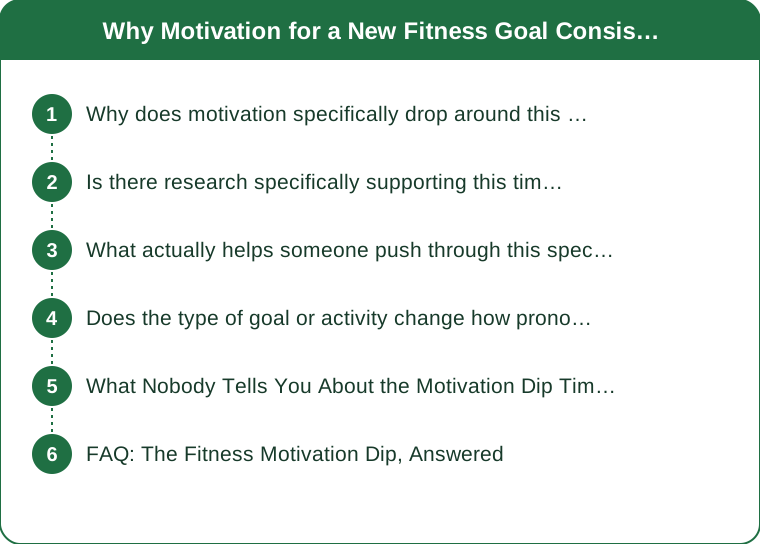
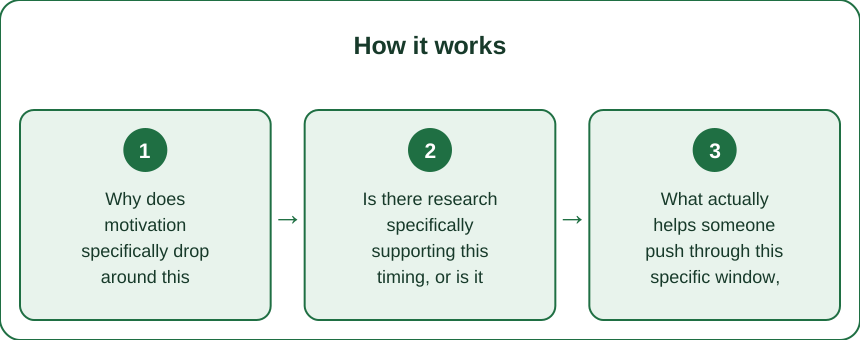
Why does motivation specifically drop around this two-to-three week window rather than earlier or later?
Starting something new produces an initial novelty-driven motivation boost, partly dopamine-related, that reliably fades over roughly two to three weeks as the activity stops feeling new and exciting. Habit formation research suggests genuine automaticity — where a behavior starts running with less conscious effort — typically takes meaningfully longer than three weeks to develop, which creates a specific gap window where the initial excitement has faded but the habit hasn’t yet become self-sustaining.
Is there research specifically supporting this timing, or is it more anecdotal?
Commonly cited habit-formation research suggests the median time to build a genuinely automatic habit is closer to two months, not the often-quoted “21 days,” which means the early weeks — right around where the novelty-driven boost has faded — represent a real motivational low point before the habit has had time to become easier to maintain. This gap is a structural, near-universal feature of habit formation, not a sign of unusual weakness in any one person’s willpower.
What actually helps someone push through this specific window, rather than just white-knuckling it?
Reducing reliance on motivation entirely during this window, by pre-committing to a specific, low-friction plan (a fixed time, a workout buddy, a very short non-negotiable minimum session) works better than trying to manufacture more motivation. Since the dip is expected and temporary, treating it as a predictable phase to plan around, rather than a signal that the goal itself was wrong, changes how it gets handled.

Does the type of goal or activity change how pronounced this dip is?
Somewhat — activities that are highly novel and different from prior routine (an entirely new sport or class format) tend to show a more pronounced novelty-driven initial boost and a correspondingly bigger dip once that novelty fades, compared to a familiar activity being resumed after a break. Building in variety or a small new element right around this window can sometimes extend the novelty effect just long enough to bridge into more established habit territory.
What Nobody Tells You About the Motivation Dip Timing
Outfit and gear excitement specifically follows the same novelty-driven curve as workout motivation itself, which is part of why buying new workout clothes right at the very start of a fitness goal, when motivation is already naturally high, provides less net benefit than saving a smaller gear refresh for right around this predictable dip window, when the psychological boost is actually needed most.
FAQ: The Fitness Motivation Dip, Answered
Does everyone experience this dip at exactly the same point?
The general two-to-three week window is common, though the exact timing varies somewhat by individual and by how novel the specific activity is compared to prior routine.
Is it a bad sign if motivation hasn’t dipped by day seventeen?
Not at all — some people experience a more gradual decline rather than a sharp dip, and either pattern is normal; the underlying gap between fading novelty and habit automaticity still applies either way.
What’s the single most effective planning tool for this specific window?
Pre-scheduling a fixed, specific time and minimum commitment (even a very short one) for the days surrounding this window removes the need to rely on in-the-moment motivation, which is precisely the resource that’s naturally at its lowest during this period.
TL;DR:
- A predictable motivation dip around week two to three comes from fading novelty before habit automaticity kicks in
- Genuine habit automaticity typically takes closer to two months to develop, not the often-cited 21 days
- Pre-committing to a specific, low-friction plan works better than trying to manufacture more motivation
- Saving a small gear or outfit refresh for this window, rather than the very start, can help bridge the gap
The motivation dip that shows up right around week two or three isn’t a sign the goal was wrong — it’s a well-documented, near-universal gap in habit formation, and planning around it beats waiting for motivation to come back on its own.
Keep Reading
This article is for general informational and styling purposes only. Fit, sizing, and product availability may vary.