Why Most New Year Fitness Resolutions Actually Fail by February (And What the Data Says Helps)

Quick Answer: New Year fitness resolutions most commonly fail because they’re built around outcome goals (a number on the scale) rather than specific, schedulable process goals (three 30-minute sessions per week), and because initial motivation is treated as a strategy rather than something that predictably fades — resolutions built around concrete, scheduled actions consistently outlast vague, motivation-dependent ones well past February.
Gym parking lots are famously packed the first week of January and noticeably emptier by the second week of February. This isn’t a lack of willpower across millions of people simultaneously — research on habit formation points to a few specific, identifiable reasons this pattern repeats so reliably every year.

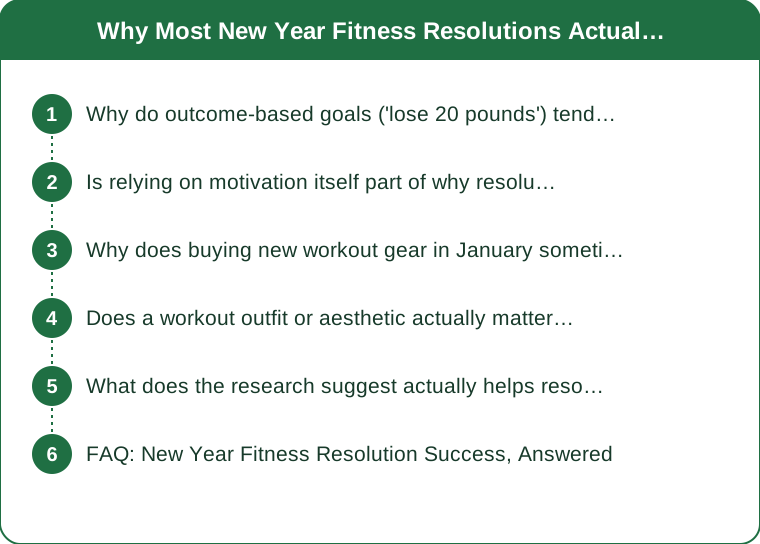
Why do outcome-based goals (‘lose 20 pounds’) tend to fail faster than process-based ones?
An outcome goal doesn’t specify what to actually do on a Tuesday, which leaves execution vague and easy to skip on a low-motivation day. A process goal (‘three 30-minute sessions this week, scheduled for Monday, Wednesday, Friday at 6pm’) removes that ambiguity entirely, making the decision to act far more automatic and less dependent on how motivated you feel in the moment.
Is relying on motivation itself part of why resolutions fail?
Yes — motivation is well-documented to be highest at the start of a new commitment and to naturally decline over subsequent weeks regardless of the goal’s importance. Resolutions that don’t build in a plan for the inevitable motivation dip (habit stacking, scheduling, accountability) are more vulnerable to failing exactly when that predictable dip arrives, often right around early-to-mid February.
Why does buying new workout gear in January sometimes correlate with lower long-term follow-through?
This is a documented pattern sometimes called the ‘false hope syndrome’ in behavior research — the act of preparing (buying gear, joining a gym) can create a premature sense of accomplishment that substitutes for the actual behavior change, especially when the gear or outfit itself becomes the focus rather than a scheduled, specific action plan.

Does a workout outfit or aesthetic actually matter less than showing up consistently?
By a wide margin — consistency in scheduled process goals is what the behavior-change research consistently points to as the strongest predictor of habit formation, far outweighing any effect from having the ‘right’ workout outfit, which matters far less to actual outcomes than people assume when starting out.
What does the research suggest actually helps resolutions survive past January?
Specific implementation intentions (exact day, time, and location for each session, decided in advance), starting with a smaller, more sustainable commitment than the ambitious version, and building in accountability (a workout partner, a coach, a tracked calendar) all show measurably better long-term adherence than a vague, high-effort resolution alone.
FAQ: New Year Fitness Resolution Success, Answered
Is it better to start small in January rather than going all-in immediately?
Yes — research on habit formation consistently favors a smaller, more sustainable starting commitment over an ambitious one that’s harder to maintain once initial motivation fades.
Does tracking progress actually improve resolution follow-through?
Yes — regular tracking (even simple checkbox tracking of completed sessions) is associated with meaningfully better adherence than relying on memory or general intention alone.
Why does the gym crowd specifically thin out around early-to-mid February?
This timing lines up closely with the well-documented point where initial motivation has typically faded for people who built their resolution around motivation alone rather than a scheduled process goal.
TL;DR:
- Vague outcome goals fail more often than specific, scheduled process goals with exact days and times
- Motivation reliably declines over weeks, and resolutions without a plan for that dip are most vulnerable
- New gear or gym memberships can create a false sense of progress that substitutes for the actual habit
- Smaller, sustainable starting commitments with tracking and accountability show measurably better long-term follow-through
Before setting next year’s resolution, replace the outcome goal with a specific scheduled process goal — it’s the single change most supported by actual habit-formation research.
Keep Reading
This article is for general informational and styling purposes only. Fit, sizing, and product availability may vary.