Why Buying the Gear First Predicts Quitting - and What to Buy Instead

Quick Answer: Buying gear before starting feels like commitment but often functions as a substitute for it. The purchase delivers the reward - the sense of having begun - before any of the work happens, which drains the motivation that was meant to fund week one. It also creates a sunk cost that turns a missed session into guilt rather than a shrug. Buy the minimum that removes a genuine obstacle, then upgrade only after four weeks of showing up.
And late August is peak season for this particular mistake, because the fall-restart impulse arrives with a full wallet.

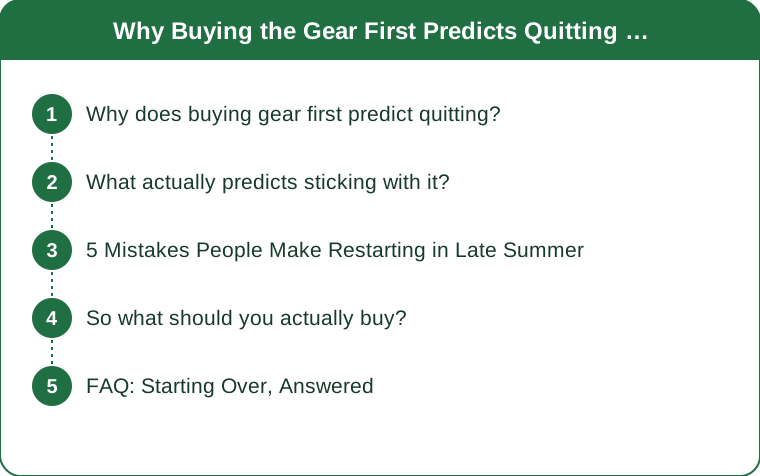
Why does buying gear first predict quitting?
Because it collects the reward at the wrong end of the process.
The purchase itself feels like progress. Choosing, comparing, and ordering all involve thinking hard about your goal, and that thinking produces a genuine sense of momentum. The problem is that the momentum gets spent on the shopping rather than banked for the training. By the time the box arrives, the emotional peak has passed.
It sets the start line too far away. If the plan is to begin when the shoes arrive, you have handed your start date to a delivery driver. Every day of shipping is a day of not starting that feels justified, and justified delays are the hardest ones to break.
Sunk cost turns misses into guilt. Skipping a session when you own nothing costs nothing. Skipping when there is a £180 kit in the hallway adds a layer of self-reproach - and guilt is a famously poor motivator for the specific act of putting on shoes.
And identity gets front-loaded. Buying the equipment of a runner lets you feel like a runner before running. That feeling is meant to be earned in arrears, where it reinforces behaviour that already happened.
What actually predicts sticking with it?
The research-adjacent answer and the practical answer point the same way.
Reducing friction beats increasing motivation. The strongest predictor of a repeated behaviour is how few decisions stand between you and it. Laying clothes out the night before does more than any purchase, because it removes the choice point where quitting happens.
A fixed time beats a fixed goal. People who attach a habit to an existing anchor - after the school run, before the first coffee - keep it longer than people aiming at a target number. The anchor survives a bad week; the target does not.
Sessions short enough to feel unreasonable to skip. Ten minutes is not an impressive training stimulus, and it is an excellent habit stimulus. The first four weeks are about attendance, not adaptation.
A ceiling, not just a floor. Capping your first two weeks - no more than 25 minutes even if you feel great - keeps enthusiasm in reserve rather than spending it all in week one. The classic failure is a brilliant first week that makes week three feel like a chore.
Evidence you can see. A wall calendar with an X for each session outperforms an app notification, mostly because it is unavoidable and unmutable.

5 Mistakes People Make Restarting in Late Summer
1. Buying for the version of you that trains five times a week. You will train two or three. Buy for that person and let the fourth session earn its own gear.
2. Starting the day the weather breaks. The first cool morning of September produces a wave of ambitious first sessions and a matching wave of week-two absences. Start on an ordinary day, in ordinary conditions, so the habit does not depend on a mood the weather created.
3. Treating September like January. The impulse is the same and so is the failure curve. The difference you can create is scale - a September restart at one third the ambition of a January one has a far better survival rate.
4. Buying cold-weather gear in August. You do not yet know what your routine looks like, so you do not know whether you need the running jacket or the indoor mat. Wait until the routine tells you what it needs.
5. Announcing it widely on day one. Public declaration gives you social credit immediately, which is the same trap as buying the gear - reward before behaviour. Tell one person who will ask you about it in three weeks.
The third mistake is the one that surprises people, because September genuinely is a better restart month than January - it just does not survive January-sized ambition.
So what should you actually buy?
A short list, in the order the need appears.
Shoes that fit, if what you are doing involves impact. This is the one genuinely non-negotiable purchase, because ill-fitting shoes create a real obstacle and a real injury risk. Get fitted rather than guessing, and buy one pair.
One outfit you like enough to wear repeatedly. Not seven. One set that fits properly and washes fast removes the laundry excuse without creating a wardrobe you have to justify.
A sports bra with the right band size, if applicable - probably the highest-impact single purchase for comfort, and the one most often left in the too-hard pile.
Nothing else for four weeks. No tracker, no mat, no bands, no supplements. After four weeks of attendance, your routine will have told you what it is missing - and that information is worth more than any pre-purchase research.
Then upgrade one thing. Buying as a reward for four consistent weeks reverses the sequence: the purchase now reinforces behaviour that already exists. It also means the money goes toward equipment you have proven you will use.
A reasonable starting budget is one pair of shoes and one outfit - which for most people is a fraction of the kit they were about to order, and considerably more likely to still be in rotation at Christmas.
This is general information, not medical advice - if you are returning after an injury or a long gap, a professional assessment is worth more than any of it.
FAQ: Starting Over, Answered
Is it wrong to buy nice workout clothes at all?
No - clothes you like genuinely reduce friction. The issue is timing and volume. One good set before you start is fine; a full wardrobe is the purchase acting as a substitute for the habit.
How long before I know if a routine will stick?
Roughly four to six weeks. The dangerous window is days 14 to 21, when novelty has worn off and results have not appeared. Anything that survives day 21 has a much better outlook.
Should I start now or wait until September?
Now, at a smaller scale. Waiting for a clean start date is the same delay mechanism as waiting for a delivery. Two easy sessions this week beats an ambitious plan that begins on the first.
What if I already bought everything?
Nothing is lost - just do not let the kit set the standard. Use the shoes, ignore the rest, and start at the ten-minute scale you would have started at anyway.
Do fitness trackers help or hurt?
Both. They help with awareness and hurt when a missed target reads as failure. If you buy one, buy it in week five, not week zero.
Why does week three feel so much harder than week one?
Novelty has faded, visible results have not arrived, and the initial motivation has been spent. This is the normal shape of a new habit, not evidence that it is not working.
TL;DR:
- Buying gear first collects the reward before the behaviour, draining the motivation that week one needed.
- It also outsources your start date to a delivery and turns missed sessions into guilt via sunk cost.
- What actually predicts sticking: less friction, a fixed anchor time, sessions short enough to feel silly to skip, and a ceiling on week one.
- Buy shoes that fit and one outfit - then nothing for four weeks.
- Upgrade as a reward at week five, when the purchase reinforces a habit that already exists.
A September restart has better odds than a January one, mostly because the ambition is smaller. Keep it that way, and buy the jacket in October when you have proven you will be outside to wear it.
Keep Reading
This article is for general informational and styling purposes only. Fit, sizing, and product availability may vary.