Why a September Restart Outperforms a January One

Quick Answer: A fall restart outperforms January because the calendar naturally resets in September, weather is genuinely favorable for outdoor activity, gyms are less crowded, and there is no cultural pressure creating an all-or-nothing framing. Start now with a smaller commitment than feels right and you enter January already established rather than starting over.
January gets all the attention and produces most of the abandonment.
The gym is packed on the second and back to normal by mid-February, and everyone involved knows this and does it anyway.
Meanwhile the last week of August and the first weeks of September are structurally one of the best moments of the year to build something — and almost nobody frames it that way.

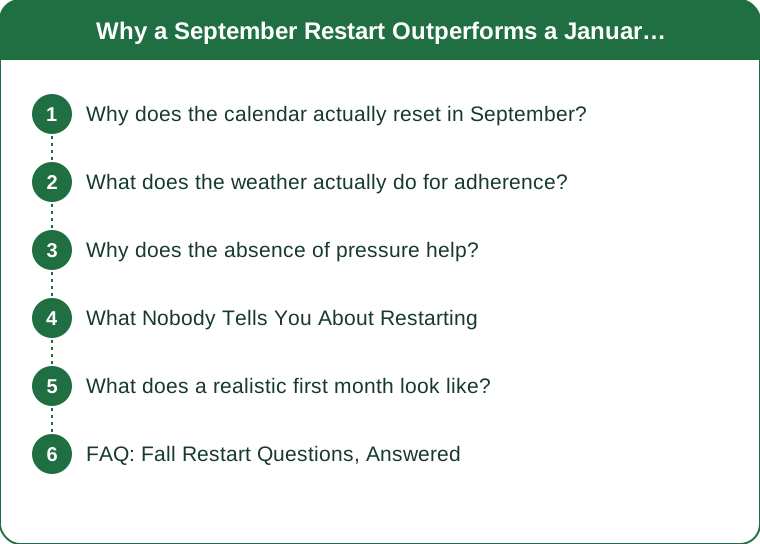
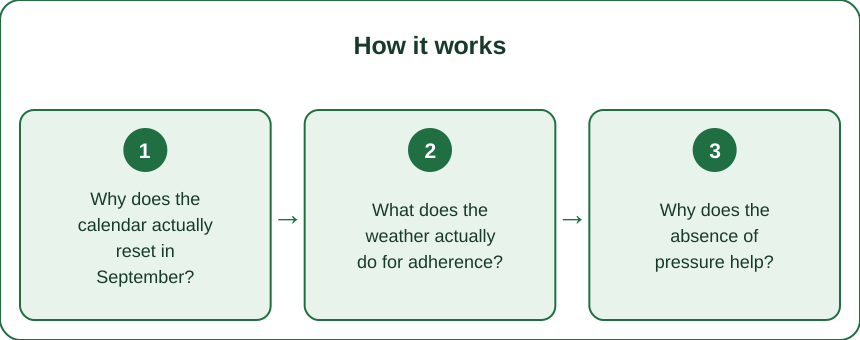
Why does the calendar actually reset in September?
Because it does, functionally, for a majority of adults.
The school year drives the rhythm of most households, and even people without children live inside a culture organized around it. Schedules that scattered across summer reassemble. Standing commitments resume. Travel drops sharply.
That predictability is the raw material of habit formation. Habits require consistent context — same time, same place, same cue — and September delivers exactly that after a summer that systematically destroyed it.
January, by contrast, arrives immediately after two weeks of maximum schedule disruption. You are building a routine from the least representative moment of the year, and the first normal week does not arrive until mid-January, by which point the initial motivation has already spent itself.
The practical implication: start when your schedule stabilizes, not when the number on the calendar changes. For most people, that is right now.
What does the weather actually do for adherence?
It removes friction, and friction is what determines whether a habit survives its first month.
Early fall in most of the US is the best outdoor exercise weather of the entire year — 50s and 60s, low humidity, long enough daylight. Compare that to January, when starting a walking or running habit requires cold, darkness, and often ice.
This matters more than motivation does. Every barrier between deciding and doing is a place where a new habit fails, and weather is one of the largest.
Concrete advantages available right now:
- Outdoor activity requires no facility, no membership, and no commute. The lowest-friction option available.
- Daylight before and after typical work hours still exists, which will not be true in six weeks.
- Comfortable temperatures mean no gear investment. January starts require an outlay before the habit is established, which is exactly backwards.
The window is real and it is closing. Habits established in September carry through November’s darkness far more reliably than habits attempted in November, because by then they are automatic rather than effortful.
Why does the absence of pressure help?
Because January’s all-or-nothing framing is what causes most abandonment.
A New Year’s resolution carries cultural weight: a fresh start, a new you, a transformation. That framing makes any deviation feel like failure of the whole project. Miss three days in January and the resolution feels dead. Miss three days in September and it is just a week where you missed three days.
There is also no audience. Nobody asks about your September fitness plans, which means nobody is tracking whether you kept them — and the absence of that scrutiny turns out to help considerably.
Practical differences that follow:
- You can start smaller without feeling like you are underselling a resolution.
- Deviation does not read as failure, so the recovery from a missed week is much faster.
- You are not competing for equipment or class spots. Gyms in September are near their annual low for crowding.
- You get four months of practice before January, which means you enter the crowded season as an established regular rather than a beginner.
That last point is the quiet advantage. While everyone else is starting in January, you will be four months in.

What Nobody Tells You About Restarting
Starting smaller than feels right is the highest-return decision available. The urge is to start at the level you eventually want. Almost everyone who succeeds long term started below their capacity and let the habit establish before the volume increased. Two twenty-minute sessions a week for a month is not modest — it is strategic.
The first two weeks are about attendance, not quality. Fitness gains from the first fortnight are negligible regardless of what you do. What matters is showing up, so optimize entirely for consistency and completely ignore intensity.
You are not starting from where you left off. Whatever you could do in March is not the starting point now, and attempting it is the most common way restarts end in injury. Start at roughly 60 percent of remembered capacity for the first two weeks.
Your old routine may not fit your current life. People restart the program that worked three years ago and it fails, then conclude they lack discipline. The 6am schedule that worked before your job changed is not the same commitment now. Build for the life you have.
Fall is the last easy window for outdoor habits. By mid-November the friction rises substantially in most climates. What you establish in the next eight weeks determines whether you have something to maintain through winter or something to restart in January.
Momentum from a fall start compounds into an entirely different January. Instead of beginning, you will be adjusting — and adjusting an existing habit is dramatically easier than creating one.
What does a realistic first month look like?
Deliberately unambitious, and structured for survival rather than results.
Weeks 1–2: Attendance only.
- Two or three sessions, 20 to 30 minutes each.
- Same days, same time, every week. The consistency of the slot matters more than what happens in it.
- Intensity comfortable throughout. If you finish wanting more, that is correct.
Weeks 3–4: Add structure.
- Same frequency, extend to 30 to 40 minutes.
- Add one harder element per week — an interval, a heavier set, a longer walk.
- Start recording something. One line per session.
Weeks 5–8: Build.
- Add a fourth session if the first three are automatic. If they are not, do not add anything.
- Now intensity can rise.
- Reassess: what is working, what is friction, what needs to change before the weather turns.
Two rules that determine the outcome:
Never miss twice. One missed session is nothing. Two consecutive is where habits die. If you miss, the next one is non-negotiable regardless of how short it is.
Set an eight-week horizon, not a permanent one. “Through the end of October” is a commitment you can actually evaluate. “Forever” is not, and it makes every day feel like a referendum.
This is general information, not medical advice. If you have been inactive for a long stretch or have any medical concerns, a conversation with a clinician before starting is worth the time.
FAQ: Fall Restart Questions, Answered
Is there anything actually special about September, or is this just reframing?
Both, and the structural parts are real: school-year schedule stabilization, favorable weather, and low gym crowding are measurable conditions, not motivational framing. The reduced psychological pressure is a genuine advantage on top of those.
What if I have restarted and failed many times before?
Then the most useful change is starting smaller than you think is worthwhile. Repeated failed restarts almost always share a pattern of starting at too high a volume. Two twenty-minute sessions a week, sustained for a month, breaks that pattern.
How do I keep it going when the weather turns?
Decide the indoor version now, while motivation is high and the decision is easy. Knowing exactly what November looks like — which sessions move indoors, and where — removes the decision at the moment you will least want to make it.
TL;DR:
- September resets the calendar functionally, which is what habit formation actually requires.
- Early fall weather removes the friction that sinks January outdoor starts.
- No cultural pressure means no all-or-nothing framing, so a missed week does not end anything.
- Start at 60 percent of remembered capacity and optimize the first two weeks for attendance only.
- Never miss twice, and set an eight-week horizon rather than a permanent one.
The genuinely useful part is the timing math. Start now and January finds you four months in, adjusting something that already exists — which is a completely different experience from standing in a crowded gym on the second of the month.
Keep Reading
This article is for general informational and styling purposes only. Fit, sizing, and product availability may vary.