Why a Deadline Goal Beats an Open-Ended One, Until the Deadline Passes

Quick Answer: A deadline creates urgency, makes progress measurable against a fixed point, and recruits commitment from other people, which is why event-based goals produce better adherence than open-ended intentions. The same structure is what causes the crash afterward: the goal was the reason to train, so when it is achieved or missed, the reason is gone. The fix is to set the next commitment before the current one arrives, and to convert at least one part of the training into something you do regardless of any event.
You sign up for the race, or the challenge, or the eight-week thing. Training goes well. You show up when you do not want to. It works.
Then the event happens and you train twice in the following month. Everyone recognises this pattern and most people conclude they lack discipline. The actual explanation is more useful than that.

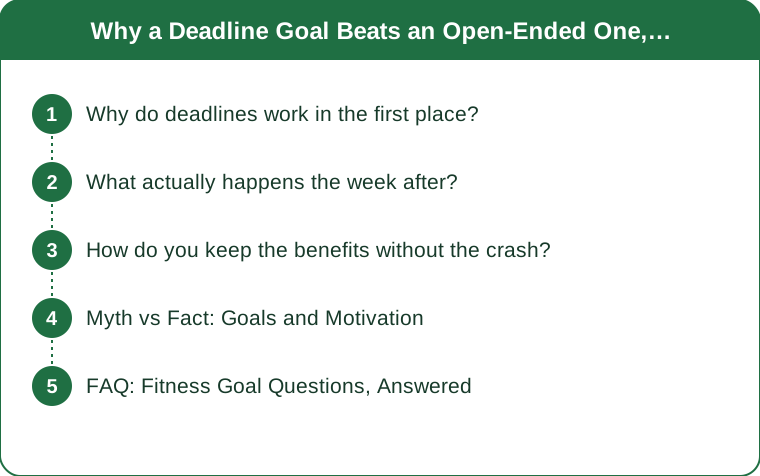
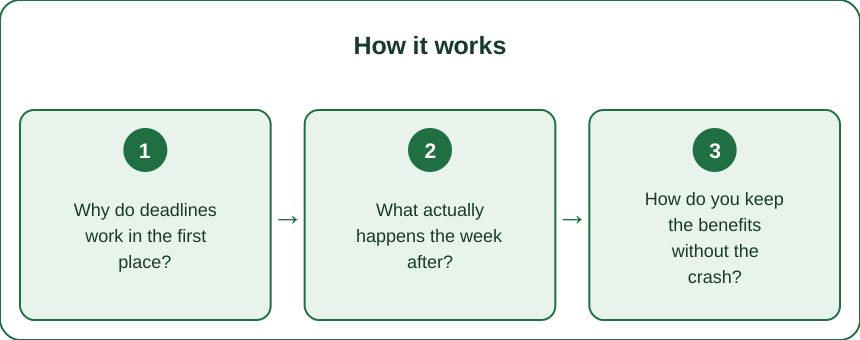
Why do deadlines work in the first place?
Four mechanisms, and they are genuinely powerful.
1. Urgency solves the tomorrow problem. An open-ended goal can always be started tomorrow at no apparent cost. A deadline makes each skipped session cost something concrete, which converts an abstract intention into a decision with consequences.
2. Progress becomes measurable against a fixed reference. Getting fitter is hard to perceive week to week. Being able to run 10km in six weeks when you can currently run 4km is legible. The clarity of the target is doing as much work as the deadline itself.
3. Public commitment recruits accountability. Telling people you have entered something makes not doing it socially costly. This effect is well documented and it is one of the reasons event entries outperform private resolutions.
4. Sunk cost, in a useful direction for once. Having paid an entry fee produces a real reluctance to waste it. This is not rational in strict economic terms and it works.
What the research says about goal specificity. Decades of goal-setting research find that specific, challenging goals produce better performance than vague ones such as do your best, and that the effect is strongest when there is feedback on progress and commitment to the goal. A dated event supplies all three conditions at once.
Which is exactly why it fails afterward. Every one of those four mechanisms is attached to the date. Remove the date and none of them is operating.
What actually happens the week after?
A predictable sequence that has both psychological and physiological components.
Physiologically, after a demanding event you genuinely need recovery, and the standard advice for a hard endurance effort is a period of reduced training. This is correct, and it also creates a gap in the routine at the exact moment the routine has lost its reason to exist.
Psychologically, several things happen at once:
- Goal completion removes the driver. The behaviour was instrumental, a means to an end, and the end has arrived.
- The post-goal flatness is well documented. People frequently report a low mood after achieving a significant goal, sometimes called post-event blues or arrival fallacy. Achieving the thing does not produce the sustained state expected.
- Identity did not have time to change. Twelve weeks is often enough to build a routine and not enough to build a self-concept as someone who trains. The behaviour was something you were doing, not something you are.
The gap is where the habit dies. Habits are maintained by consistent cues and repetition. A two-week recovery break removes the cue, and by the third week the automatic behaviour is gone and every session requires a fresh decision.
Why the second attempt often works better. People who go through this cycle two or three times frequently do stabilise, because the recovery period gets shorter, the next commitment gets made earlier, and something in the routine survives the gap. The pattern is not a permanent trait.

How do you keep the benefits without the crash?
Three structural moves, in order of how much they help.
1. Book the next thing before the current one happens. The single most effective intervention. Enter the next event two to three weeks before the current one, while motivation is high and the training is going well. This means the day after the event, there is already a reason to train, and no gap opens.
A useful spacing: far enough away to allow real recovery, close enough to matter. For endurance events, eight to sixteen weeks. For strength goals, twelve to twenty.
2. Keep one thing that is not attached to any goal. Identify one session, or one activity, that you would do whether or not anything was coming up. Often this is a walk, a class you enjoy, or one lifting session. Protect it through the recovery period at reduced intensity. It preserves the cue and the identity even when the structured training stops.
3. Plan the recovery week rather than letting it happen. A deliberate deload with reduced but scheduled sessions maintains the pattern. An unplanned break where you simply stop turns into three weeks. The difference is whether the sessions are in the calendar.
A fourth, slower move: shift the goal type. Outcome goals such as a finishing time end on a date. Process goals such as training three times weekly do not have an end. Running both at once means one survives when the other completes.
On the identity point specifically. The research on habit formation suggests that behaviours tied to self-concept persist far better than behaviours tied to outcomes. Practically, this means the sentence you use matters: I am training for a race ends, and I am someone who runs does not. This sounds like a slogan and it is a fairly well-supported distinction.
Myth vs Fact: Goals and Motivation
Myth: it takes 21 days to form a habit. Fact: research on real-world habit formation found a median of about 66 days, with an enormous range from around 18 days to over 250 depending on the behaviour and the person. Complex behaviours like structured exercise sit at the longer end. An eight-week training block is often not long enough for automaticity.
Myth: intrinsic motivation is the only kind that lasts. Fact: external structure such as events, classes, and commitments is genuinely useful, particularly early on. The evidence suggests external motivators work well and work best when they are gradually accompanied by internal ones, rather than being replaced by them.
Myth: the crash means you were never really committed. Fact: the crash is a structural consequence of goal completion, and it happens to highly committed people constantly. The commitment was real and it was attached to something with an end date.
Myth: you should always set a bigger goal next. Fact: escalating goals is one path and it is not the only one, and it raises the stakes each cycle until one is missed. Repeating a similar goal, or setting a maintenance goal, is a legitimate and underused option.
Myth: motivation causes action. Fact: the relationship runs in both directions, and the action-first direction is more reliable. Showing up when unmotivated generally produces motivation afterward, which is why the calendar matters more than how you feel on the day.
What nobody tells you: the taper is where the plan for afterward should be made. In the final week or two before an event, training volume drops and you have time and clarity. This is the ideal moment to book the next thing and to write down which sessions survive the recovery period. Making that plan afterward, in the post-event flatness, almost never happens.
On missed goals specifically. If the event does not go well, the crash is usually worse, because there is no achievement to offset it. The same structural fix applies and it is harder to execute. Booking the next thing in advance protects against this case particularly well, since the decision was made before the outcome was known.
Seasonal note: the autumn event season is ending for many people over the next several weeks, which puts a large number of people into exactly this gap at the same time, right as the days get shorter and outdoor training gets less appealing. If you have something coming up in the next month, the taper conversation above is worth having now.
FAQ: Fitness Goal Questions, Answered
Why do I stop training after a race or a challenge ends?
Because the deadline supplied the urgency, the measurable target, and the accountability, and all three end on the same day. The recovery gap then removes the habit cue before a new reason to train appears.
How long does it actually take to build an exercise habit?
Research on real-world habits found a median of around 66 days, with a very wide range. Structured exercise sits at the longer end, so an eight-week block often ends before the behaviour becomes automatic.
Should I always set a bigger goal after finishing one?
Not necessarily. Escalating goals raises the stakes each cycle until one is missed. Repeating a similar goal, or setting a maintenance target, works and is used far less often than it should be.
TL;DR:
- Deadlines work because they create urgency, a measurable target, and accountability, and all three vanish on the date.
- The post-event gap kills the habit, because the cue disappears before the behaviour is automatic.
- Book the next commitment two to three weeks before the current one, during the taper, not afterward.
- Keep one session that exists regardless of any goal. It preserves the routine through every recovery period.
If you have something coming up, enter the next one this week. It is the highest-return five minutes available.
Keep Reading
This article is for general informational and styling purposes only. Fit, sizing, and product availability may vary.