The August Reset: Why Mid-Year Fitness Goals Outlast January Resolutions

Quick Answer: Late August outperforms January as a fitness starting line for structural reasons: the fresh-start effect works on any meaningful boundary (new school year, post-vacation, season change) and September’s boundary comes with routine returning rather than departing — stable schedules, cooling weather that makes movement pleasant, empty-enough gyms, and four months of runway before holiday chaos instead of four weeks of winter darkness. Use the same playbook that makes any start stick — one keystone habit, scheduled implementation intentions, a two-minute floor for bad days — and aim it at the last week of August, the calendar’s best-kept secret.
January resolutions carry the worst conditions of the year: dark mornings, packed gyms, post-holiday fatigue, and a goal chosen at midnight. The August reset carries the opposite bundle — and behavioral science says the boundary you start on matters less than the conditions right after it. The conditions right after this week are the best the calendar sells.

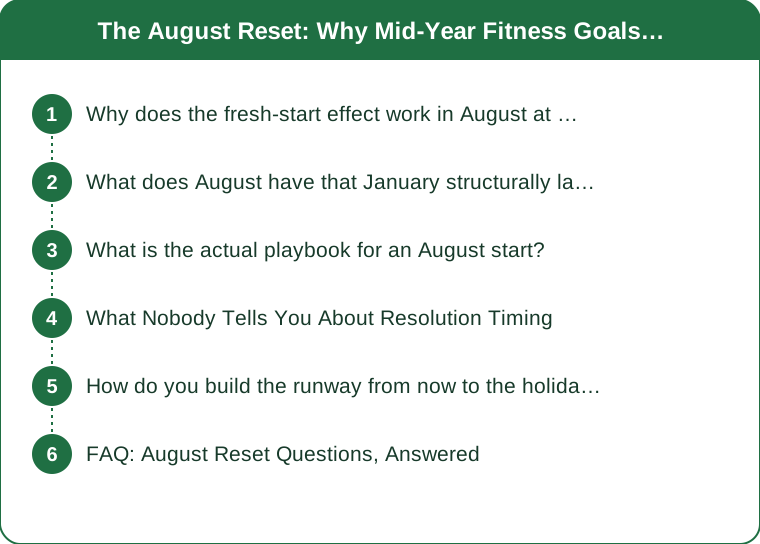
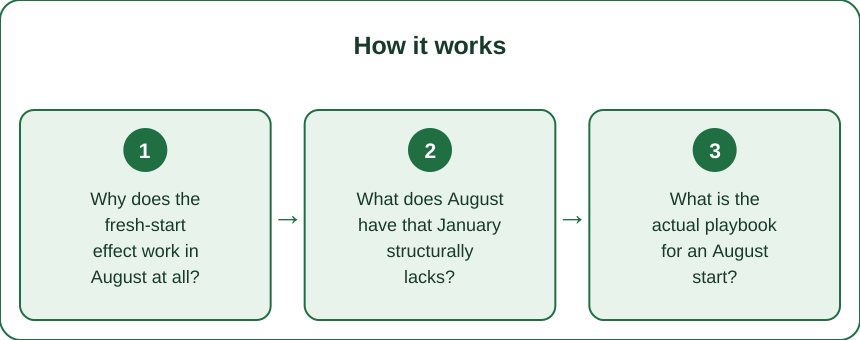
Why does the fresh-start effect work in August at all?
Because the effect was never about January — it is about temporal landmarks, and August has one of the year’s biggest.
The fresh-start research found that motivation for goal pursuit spikes at any boundary that separates old-you from new-you: Mondays, birthdays, new months, new semesters. The mechanism is psychological bookkeeping — a landmark closes the account on past failures and opens a clean ledger, which raises willingness to attempt and confidence in the attempt. January 1 is simply the loudest landmark, not the most effective one.
The September boundary is the strongest non-January landmark most adults experience, because school rhythms structured our first two decades and still structure family life: summer’s schedule chaos ends, routines crystallize, and the year genuinely restarts for anyone with kids, a campus, or a September work cadence. The back-to-school reset is a fresh start with logistics attached.
And the logistics are the point. A landmark supplies ignition; conditions determine whether the engine keeps running. January’s ignition fires into darkness, cold, crowded gyms, and holiday debt — the highest-friction month on the calendar. September’s fires into stabilizing schedules, cooling air, and a long unbroken runway. Same spark, opposite kindling.
Which is why the quiet pattern exists: ask people with multi-year streaks when they actually started, and a striking share say some ordinary week in late summer or fall — the resolution that never had to be resolved.
What does August have that January structurally lacks?
Five conditions, each one a documented adherence factor.
Routine is arriving, not leaving. Habits form fastest inside stable context — same time, same cue, same sequence — and September is the year’s great stabilizer: school schedules lock, work calendars refill, and the day develops fixed slots a workout can bolt onto. January habits have to survive winter’s disruptions with no anchor; September habits get carried by them.
Weather is moving toward you. The next ten weeks trend from hot toward crisp — each week of an outdoor walking or running habit gets more pleasant than the last, the exact opposite of a January runner’s forecast. Behavior that gets easier over time survives; behavior that gets harder needs willpower January already spent.
The gym is empty and stays empty. The January crowd peaks in week two and creates equipment lines exactly when beginners most need low-friction sessions. Late August floors are quiet, and the September uptick is a fraction of January’s — you learn the machines in peace.
The runway is four months, not four weeks. A habit started now has until late November before the first real disruption (holidays), which clears the 10-to-12-week zone where routines consolidate. January’s habit meets Valentine’s fatigue at week five.
And daylight still exists. Evening walks and morning sessions happen in light for two more months — the single most underrated adherence variable, and the one January owns least.
What is the actual playbook for an August start?
Small, scheduled, and welded to the September structure. Four moves:
Pick one keystone, not a program. The evidence on multi-habit overhauls is brutal — change one behavior and success rates are decent; change three at once and everything fails together. Choose the single habit with the biggest spillover: three strength sessions a week, or a daily 20-minute walk, or a fixed sleep time. The rest gets added in October on top of a habit that exists.
Write implementation intentions, not intentions. “I will work out more” fails; “Tuesday and Thursday at 6:30, after I drop the kids, I do the 25-minute session, in the clothes I laid out the night before” succeeds at multiples of the vague version. When-where-how is the format; the calendar is the contract. Bolt each session to a September fixture — after drop-off, before the first meeting, during practice.
Install the two-minute floor. Pre-decide the bad-day version: five minutes of movement, one set, a walk to the corner. The floor exists to protect the streak’s identity — missing once is noise, but the all-or-nothing rule turns one missed Tuesday into a quit. Consistency research is unanimous that the never-zero pattern beats the perfect-then-collapse pattern by a mile.
Spend friction-removal money, not motivation money. Lay out clothes the night before, keep the bag packed by the door, choose the gym on the commute rather than the nicer one across town. If new leggings or shoes get you out the door, that is not vanity — reducing the number of decisions between waking and moving is the entire game. Every removed step is worth more than every added inspiration.

What Nobody Tells You About Resolution Timing
The September start has a stealth advantage January can never have: nobody is watching. January resolutions are public performances — announced, tracked, and abandoned on a shared schedule that makes quitting feel normal because everyone visibly is. An August start has no cultural script and no cohort of quitters to join; the habit grows in private until it is simply a fact about you. By the time January arrives, you are the person the resolution-makers are trying to become — and immune to the season’s boom-bust energy.
The fresh-start effect also has a documented dark side worth knowing: a landmark can disrupt a working streak by resetting the ledger — the new-year energy that launches beginners sometimes unsettles established routines into experiments (“new year, new program”) that break what worked. The August version carries less of this risk precisely because it is quieter: no cultural pressure to overhaul, just conditions favoring continuation.
Goal type matters as much as start date: approach goals (build the walking habit, hit three sessions) sustain far better than avoidance goals (lose the vacation weight, stop being lazy) — and August’s natural framing is approach-flavored, a season starting, while January’s is repentance-flavored, a season atoned for. Frame the reset as the fall routine beginning, not the summer being corrected.
And if a start slips — this week becomes next week becomes October — the research has one more gift: landmarks recur weekly. The fresh-start effect fires on Mondays too, at smaller amplitude. The best boundary is the nearest one you will actually use.
How do you build the runway from now to the holidays?
Treat September-to-Thanksgiving as one twelve-week season with three acts.
Act one, weeks one to four — establish. The keystone habit only, at deliberately easy intensity: sessions that end with something left, walks that finish pleasant. The goal of act one is showing-up percentage, not fitness — 80 percent attendance at easy effort beats 100 percent effort at 40 percent attendance, because act one is when the identity forms. Log every session somewhere visible; streaks are cheap fuel and they work.
Act two, weeks five to eight — load. The habit exists; now it can carry weight. Add the second variable: heavier sets, a third weekly session, ten more minutes. One addition per two weeks, and the two-minute floor stays in force — October’s schedule surprises are act two’s main opponent, and the floor is how they lose.
Act three, weeks nine to twelve — prove. Ride the now-automatic routine into November and bank a visible result: a 5K on a crisp morning, a rep milestone, a photographed twelve-week comparison. The proof matters because it converts the habit from an experiment into an asset worth defending — which is precisely the mindset that survives the holidays.
Then hold through December on maintenance terms — the floor version, twice a week, zero guilt — and arrive at January 1 with the strangest possession on the block: a four-month-old routine on the day everyone else is starting one. The resolution crowd will be lining up for the squat rack you have been using since August; that image is worth the whole plan.
FAQ: August Reset Questions, Answered
Is it too late in the year to see real results before January?
It is the opposite of too late — twelve-plus weeks is a complete training block, enough for beginners to add measurable strength, drop resting heart rate, and change how clothes fit. Most visible “transformations” are eight-to-twelve-week stories; the runway between now and the holidays holds one entirely.
Should I wait for September 1 for the clean boundary?
Only if the wait is days and the date is load-bearing for you — the boundary’s value is psychological ignition, and any nearby Monday carries the same charge at 90 percent. What kills starts is the waiting habit itself: a start deferred two weeks for a cleaner date is usually motivation quietly leaking, not planning.
What if my schedule is still chaotic until school actually starts?
Start the floor version now — the five-minute daily minimum — and schedule the full version for the week routines lock. This does the two-part job: the identity and streak begin today in chaos-proof size, and the real sessions launch into the stable slots the moment they exist. Chaos weeks are what the two-minute floor was built for.
Do I need a gym membership for this, or can the reset be home-based?
The playbook is location-agnostic — keystone, scheduled slots, floor, friction removal — and home starts often stick better because they remove the commute-friction entirely. The honest criterion: pick the venue with the fewest steps between deciding and doing. A pair of dumbbells, a mat, and the leggings already in the drawer beat an aspirational membership across town every recorded time.
TL;DR:
- The fresh-start effect fires on any real boundary, and the back-to-school reset is the year’s strongest one — with conditions January never offers: stabilizing routines, improving weather, empty gyms, a four-month runway.
- Playbook: one keystone habit, when-where-how implementation intentions bolted to September fixtures, a two-minute bad-day floor, money spent on friction removal rather than motivation.
- Run three acts to Thanksgiving — establish (attendance), load (one addition per fortnight), prove (a banked visible result) — then hold maintenance through December.
- Frame it as the fall season starting, not summer being atoned for; approach goals outlive avoidance goals.
Pick the keystone tonight, write the two weekly time slots into the calendar, and lay out clothes for the first one. January-you will walk into that crowded gym as the person with a four-month head start — which was the whole resolution, kept before it was made.
See It in Motion
Seen here: High Waist 8” Yoga Shorts — shop similar styles on bubblelime.com
Keep Reading
This article is for general informational and styling purposes only. Fit, sizing, and product availability may vary.