How to Set a Fitness Goal That Actually Survives Past January

Quick Answer: Fitness goals that survive past January are typically built around a specific, trackable behavior (like a set number of weekly sessions) rather than a vague outcome (like ‘get fit’), paired with a realistic starting frequency that can actually be sustained during a normal, busy week — not just an ideal one.
By the third week of January, gym traffic drops sharply every year, and it’s rarely a motivation problem alone — it’s usually a goal-setting problem from the very first week.

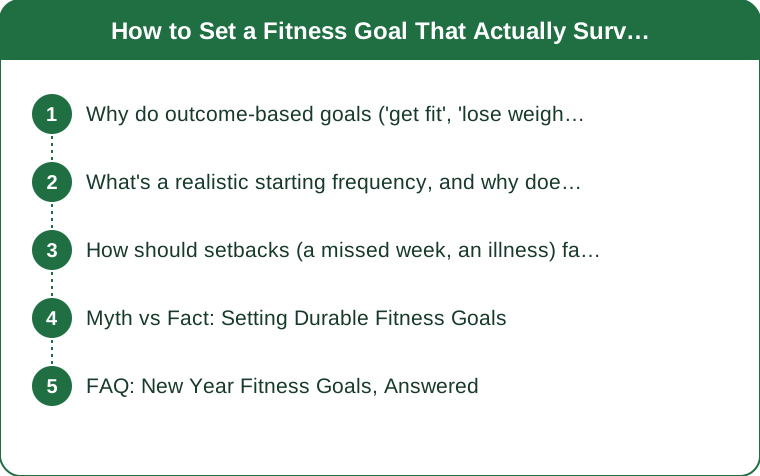
Why do outcome-based goals (‘get fit’, ‘lose weight’) fail more often than behavior-based ones?
An outcome goal describes a destination without specifying the actual repeatable action that gets you there, which leaves too much room for motivation to be the only thing holding the plan together on a low-energy day. A behavior-based goal — ‘3 strength sessions a week’ rather than ‘get stronger’ — gives you something concrete to check off regardless of how motivated you feel that day, which is a far more durable structure once initial enthusiasm fades.
What’s a realistic starting frequency, and why does ‘ideal’ backfire?
Many January plans start at an ambitious frequency (5-6 sessions a week) based on how motivated the first week feels, rather than what fits a normal, busy week months down the line. Starting at a genuinely sustainable frequency — often 2-3 sessions a week for someone new to consistent exercise — and building up gradually from a real baseline outperforms an ambitious plan that collapses the first time a busy week hits, since missing an ambitious plan repeatedly is demoralizing in a way that missing a realistic one isn’t.

How should setbacks (a missed week, an illness) factor into the original goal?
A goal set without any built-in flexibility treats a missed week as a failure of the whole plan, which is a common reason people abandon a goal entirely rather than just resuming it. Building in an explicit expectation of occasional missed sessions — treating a goal as ‘3 sessions a week, most weeks’ rather than a perfect streak — removes the all-or-nothing trap that turns one bad week into a quit point.
Myth vs Fact: Setting Durable Fitness Goals
Myth: The most ambitious goal produces the best results because it pushes you hardest. Fact: An ambitious goal that collapses within a few weeks produces far less total training volume over the year than a moderate, sustained goal — consistency over months beats intensity for a few weeks.
Myth: A specific number-based goal (weight lost, pounds lifted) is more motivating than a behavior-based one. Fact: Outcome numbers are harder to control day-to-day and more discouraging when they stall — a behavior-based goal gives a controllable daily win that sustains motivation better over time.
FAQ: New Year Fitness Goals, Answered
How specific should a fitness goal actually be to hold up long-term?
Specific enough to check off objectively — ‘strength training twice a week’ rather than ‘exercise more’ — since vague goals are harder to track and easier to quietly abandon without a clear signal that you’ve drifted from them.
Is it better to set one goal or several at once in January?
One primary behavior-based goal is generally easier to sustain than several simultaneous ones, since splitting attention across multiple new habits at once increases the odds that none of them stick past the first few weeks.
When should a goal actually be adjusted rather than abandoned?
If a goal consistently feels unsustainable after a genuine few-week trial (not just one hard week), adjusting the frequency or specifics down to a more realistic level is a better move than abandoning the goal entirely, since a scaled-down version still beats stopping altogether.
TL;DR:
- Behavior-based goals (‘3 sessions a week’) outlast vague outcome goals (‘get fit’)
- Start at a genuinely sustainable frequency, not the most ambitious one week one allows
- Build in room for occasional missed sessions rather than an all-or-nothing streak mindset
- One primary goal beats several competing new habits started simultaneously
The goals still standing by March usually weren’t the most ambitious ones in January — they were the most realistic.
Keep Reading
This article is for general informational and styling purposes only. Fit, sizing, and product availability may vary.