August Is a Better Fitness Restart Than January, and the Reason Is Boring

Quick Answer: A late-August restart benefits from long evening daylight, an incoming school-year schedule that rebuilds routine for you, and warm weather that removes the friction of getting out the door. January offers the opposite of all three, which is a large part of why January adherence collapses around week three.
Everyone waits for January. The people who quietly get in the best shape start now, and it is not discipline. It is that late summer removes four or five obstacles that January adds.

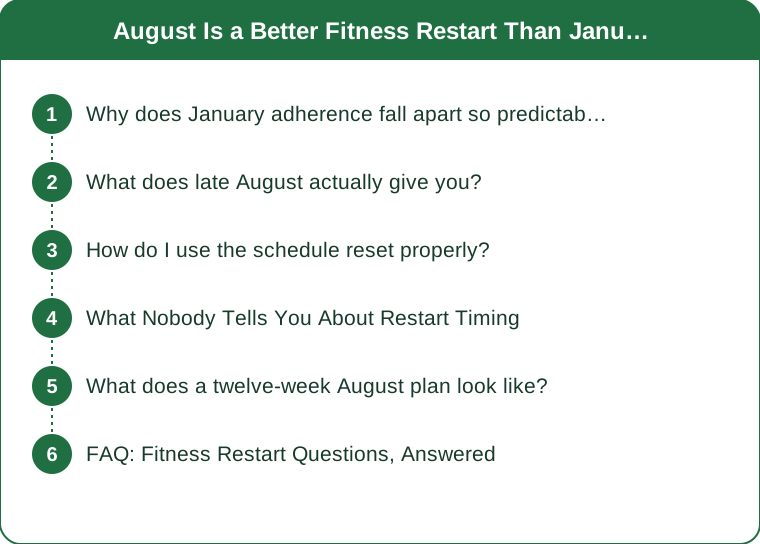
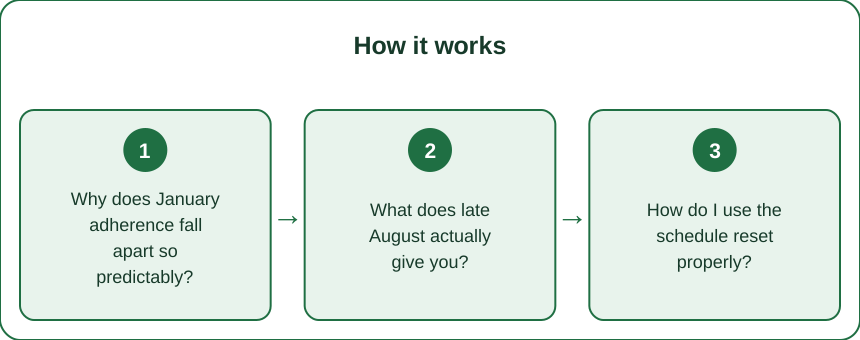
Why does January adherence fall apart so predictably?
The commonly cited figure is that a large majority of new-year resolutions are abandoned by mid-February, and behavioral research points at environment more than motivation.
January stacks obstacles: minimal daylight before and after work, cold and often wet conditions, post-holiday financial strain, and crowded gyms that make every session slower.
Motivation is high in January and friction is higher. Adherence is roughly motivation minus friction, and January maximizes the wrong term.
What does late August actually give you?
Three concrete advantages.
Daylight. Late August still offers usable light well into the evening across most of the US, which means an after-work walk or run does not require a headlamp or a treadmill.
A schedule reset that is not yours. The school year restructures households automatically in September. Attaching a new habit to an already-changing schedule is far easier than imposing change on a stable one.
A short runway to a real deadline. Twelve weeks from late August lands in mid-November, which is a genuine target with holidays right behind it. Twelve weeks from January lands in a vague spring.
How do I use the schedule reset properly?
Anchor the new habit to something that is already changing, before the change settles.
- If mornings are shifting earlier for school, attach the workout to the new wake time in week one, not week four
- If evenings gain a fixed pickup slot, put the walk immediately before or after it
- If lunch breaks change, claim the slot now while the calendar is still soft
Habits attach to existing routines far more reliably than they establish themselves. The window where a routine is being rebuilt is the cheapest time to insert something, and it closes within about three weeks.

What Nobody Tells You About Restart Timing
The best restart date is the one with the fewest disruptions in the following 21 days. Not the most symbolic date. Check the calendar for travel, deadlines, and visitors, then pick the cleanest three-week window and start there.
Starting smaller than you can handle is the actual advantage of a non-January start. Without the pressure of a resolution, most people will accept a 20-minute plan. Twenty minutes done for twelve weeks beats sixty minutes done for nine days, and that math is not close.
Late summer weather is a trap in one specific way. Heat is real, and a plan built entirely around outdoor sessions will break the first week of a heat wave. Have one indoor version of every session ready before you need it.
And the piece almost nobody accounts for: the first cold snap is the real test. Whatever you build now needs to survive early November. Build the indoor version in September while it is still optional, and you will still be training in December when the January crowd is just showing up.
What does a twelve-week August plan look like?
Simple, low-volume, and designed to survive weather.
Weeks 1-4: three sessions per week, 25 minutes each, two strength and one walk or run. Goal is attendance, not progress.
Weeks 5-8: same three sessions, add load or distance to one session per week. Add one optional fourth session.
Weeks 9-12: four sessions, one of which is indoors regardless of weather. Test something measurable in week 12.
That is it. No January reset needed, and you arrive at the holidays with twelve weeks of training behind you instead of a plan you are waiting to start.
This is general information, not medical advice. If you are returning after a long layoff or an injury, get cleared before ramping.
FAQ: Fitness Restart Questions, Answered
Is there a worst time to start?
Any week with more than two known disruptions. The date matters far less than the three weeks that follow it.
Should I still set a January goal?
Sure, but set it as a checkpoint in an existing plan rather than a start date. Arriving at January already training is a completely different experience than starting there.
What if I have started and quit five times?
Then the plan was too big, almost certainly. Cut whatever you were attempting in half and cut it in half again. The failure pattern is nearly always volume, not character.
TL;DR:
- January maximizes friction: darkness, cold, crowds, and a vague deadline
- Late August offers daylight, an incoming schedule reset, and a real 12-week runway
- Attach the habit to a routine that is already changing, within the first three weeks
- Build the indoor version in September so the first cold snap does not end it
Look at the next 21 days on your calendar and find the cleanest three-week stretch. Start there with three 25-minute sessions a week. You will be twelve weeks in by the time everyone else is writing resolutions.
Keep Reading
This article is for general informational and styling purposes only. Fit, sizing, and product availability may vary.